The Destroyer Archetype
Kali, The Destroyer
Raja Ravi Varma
c. 1905–1910
Currently At
Metropolitan Museum of Art, New York (chromolithograph edition) · Original paintings in various Indian collections
Created
c. 1905–1910
Indian Colonial Period · Late 19th – Early 20th Century
Commissioned By
Ravi Varma Press (self-published) · Mass market devotional print

Original painting · Metropolitan Museum of Art, New York (chromolithograph edition) · Original paintings in various Indian collections
Sacred Feminine Prints edition · Cathedral arch frame
The Commission
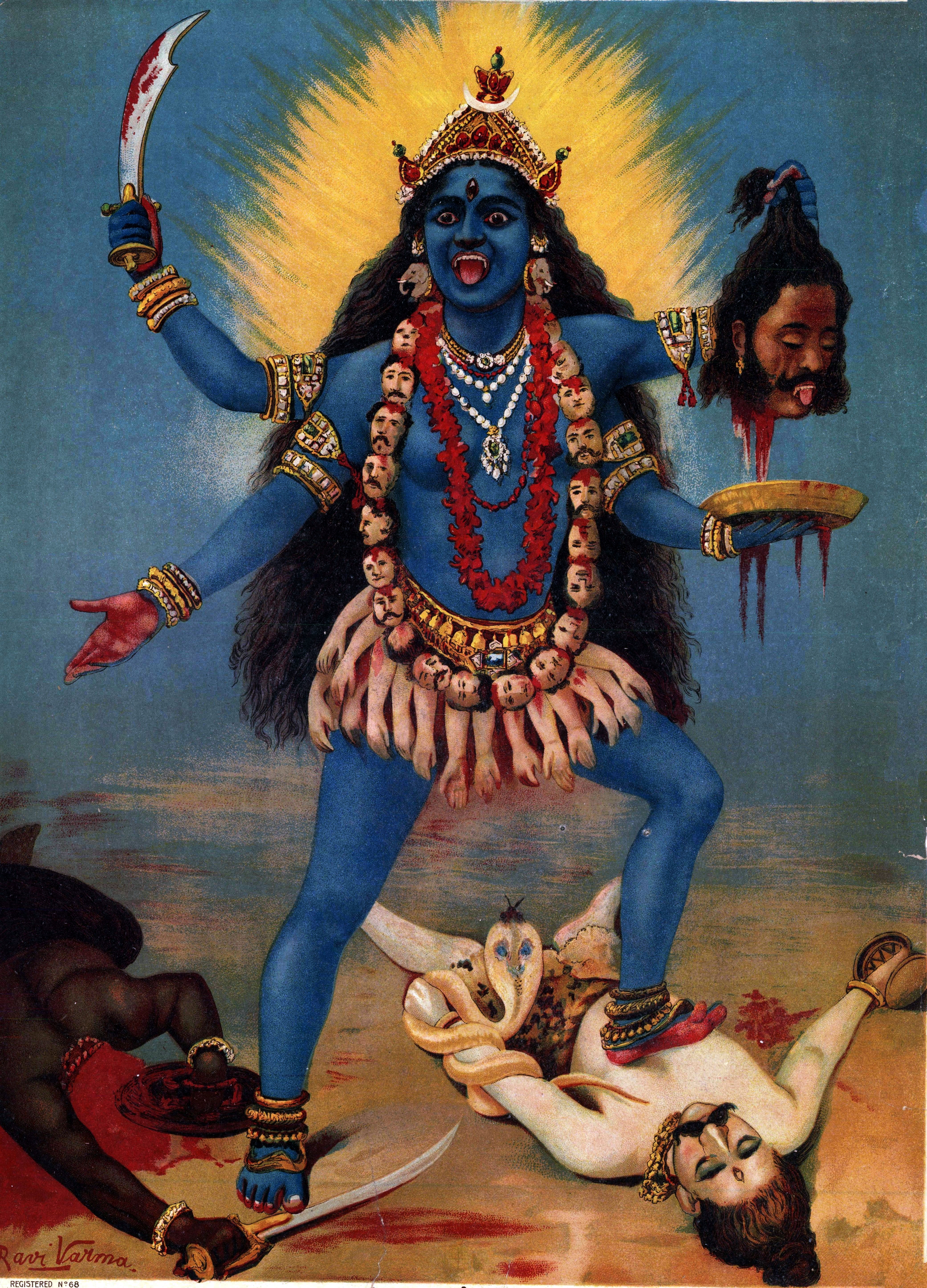
This image of Kali was produced as a chromolithograph by the Ravi Varma Press, the printing enterprise Raja Ravi Varma established in Lonavla, Maharashtra in 1894. The press was not commissioned by a single patron but was itself a revolutionary commercial venture: Varma recognized that the emerging Indian middle class — newly literate, newly urban, shaped by both Hindu tradition and British colonial modernity — hungered for affordable, beautiful images of the gods. The press produced oleographs (oil-based chromolithographs) that could be purchased for a few annas and hung in homes across the subcontinent. The Kali image became one of the most widely reproduced religious images in Indian history. It was not a unique painting for a wealthy patron but a mass-market object of devotion — which makes it, paradoxically, one of the most democratically distributed sacred images ever created.
The Painter
Raja Ravi Varma
Raja Ravi Varma (1848–1906) was the first Indian painter to achieve international recognition and the first to synthesize Western academic realism with Hindu iconographic tradition. Born into the royal family of Travancore in present-day Kerala, he was a child prodigy who taught himself oil painting by studying European works in the palace collection. He later trained under the Dutch-British painter Theodore Jensen and the court painter Ramaswamy Naicker. Varma's innovation was radical: he painted Hindu gods and goddesses with the anatomical realism, three-dimensional modeling, and atmospheric perspective of European academic painting, but dressed them in the fabrics, jewelry, and landscapes of South India. His models were often women from the royal courts and aristocratic families he served. The result was a new visual language for Hindu devotion — one that felt simultaneously ancient and modern, Indian and cosmopolitan. He worked for the courts of Travancore, Baroda, Mysore, and Indore, and his paintings were exhibited in Vienna, Chicago, and Madras. He died in 1906, celebrated as the "Father of Modern Indian Art," though later critics debated whether his Europeanized style was a creative synthesis or a colonial accommodation.
The Commissioner
Ravi Varma Press (self-published) · Mass market devotional print
The Ravi Varma Press was founded in 1894 when Raja Ravi Varma partnered with the German printer Fritz Schleicher to establish a chromolithography facility in Lonavla, near Pune. The venture was controversial from the start: conservative Brahmin scholars objected to sacred images being reproduced mechanically and sold commercially, arguing that mass-produced gods were a form of sacrilege. Varma disagreed. He believed that making divine images accessible to ordinary people — not just to temple priests and wealthy patrons — was itself a spiritual act. The press produced hundreds of images of Hindu deities, mythological scenes, and portraits of Indian royalty. After Varma sold the press in 1901 to the Calcutta Art Studio, it continued producing his designs for decades. The images shaped how an entire generation of Indians visualized their gods — and they remain the visual template for Hindu devotional imagery to this day. The Kali chromolithograph is among the most iconic products of this enterprise.
Historical Context · Indian Colonial Period · Late 19th – Early 20th Century
India in the late nineteenth century was a society under enormous pressure. The British Raj had consolidated its control after the 1857 uprising, imposing a colonial administration that systematically marginalized Indian cultural and religious institutions. At the same time, the Bengal Renaissance and the broader Indian reform movement were generating a new Hindu nationalism — a cultural pride that sought to reclaim Indian civilization as sophisticated, ancient, and spiritually superior to the materialism of the West. Kali worship was at the center of this tension. The goddess was associated with the Bengali revolutionary movement: Bankimchandra Chattopadhyay's novel Anandamath (1882) depicted Kali as the embodiment of Mother India herself, and the revolutionary Ramakrishna Paramahamsa was her most celebrated devotee. When Varma painted Kali, he was not simply illustrating a myth — he was participating in a cultural argument about what India was, what its gods meant, and who had the right to represent them. The chromolithograph press made that argument available to millions.
The Myth
Hindu Tantric tradition · Devi Mahatmya (Markandeya Purana) · Cosmic battlefield outside time
Kali's origin story is told in the Devi Mahatmya, a Sanskrit text composed around the 5th–6th century CE and considered one of the most important texts in the Shakta tradition. The demon Raktabija ("blood-seed") is terrorizing the cosmos: every drop of his blood that touches the ground spawns a new demon, making him effectively immortal. The gods, unable to defeat him, appeal to the great goddess Durga. In the heat of battle, Durga's fury becomes so intense that it bursts from her forehead as a separate being — Kali, dark as a storm cloud, wearing a garland of severed heads, her tongue extended to lap up every drop of Raktabija's blood before it can reach the ground. She dances on the battlefield, drunk on blood and destruction, until the demon is finally dead. But Kali's frenzy does not stop. She continues to dance, threatening to destroy the world itself. The god Shiva, her consort, throws himself beneath her feet. When she realizes she is standing on her husband, she stops — her tongue extended in the iconic gesture of shocked recognition. In Varma's painting, Kali stands triumphant on the prostrate body of Shiva, holding a severed head and a sword, her four arms radiating power, her yellow halo blazing against the blue sky. She is terrifying and sacred simultaneously — the destroyer who makes creation possible.
Why It Matters Today
Kali has become one of the most potent symbols of female power in contemporary culture — not despite her violence but because of it. She represents the part of feminine energy that Western culture has most systematically suppressed: the capacity for righteous destruction, for saying no, for burning down what no longer serves. In a world where women are still expected to be endlessly accommodating, endlessly nurturing, endlessly forgiving, Kali offers a different model: the goddess who destroys ego, illusion, and oppression without apology. She has been adopted by feminist theologians, by practitioners of goddess spirituality, by artists and activists who see in her image a permission to be fully, fiercely alive. The psychologist Carl Jung identified Kali as an archetype of the "terrible mother" — the shadow side of the nurturing feminine that Western culture has split off and projected onto witches, demons, and dangerous women. To bring Kali back into the home, to hang her on the wall, is to reintegrate that shadow — to acknowledge that destruction and creation are not opposites but partners.
Own This Piece
Kali, The Destroyer
Cathedral arch frame · 2ft × 4ft · Limited edition print
$460
Secure checkout via Stripe · Ships within 7–10 business days
Further Listening & Watching
Curated educational resources from museums, universities, and public broadcasters.
Podcast · BBC Radio 4
Kali — In Our Time
Melvyn Bragg and three academic guests discuss the Hindu goddess Kali in her many remarkable forms — her origin stories, iconography, and enduring significance in South Asian religion and culture.
Video · CIIS — California Institute of Integral Studies
Reading Kali and the Tantric Way
Scholar Madhu Khanna lectures on the iconography, history, and social and ecological relevance of the Hindu goddess Kali at the California Institute of Integral Studies.
Video · Christie's Education
Raja Ravi Varma: The Making of an Artist and a Nation
Historian and author Manu S. Pillai in conversation with Christie's specialist Rob Dean on Raja Ravi Varma — his artistic vision, his role in shaping modern Indian visual culture, and his legacy.
Video · Documentary
Raja Ravi Varma: Restoring a Master's Glory
Art restorer and historian Rupika Chawla discusses the preservation of Raja Ravi Varma's works and the artist's extraordinary contribution to Indian painting.
Video · Museum Lecture
Meeting Some Gods: Contemporary & Classic Visions of Hinduism
Dr. Katherine Anne Paul delivers a museum lecture exploring how Hindu deities including Kali have been depicted across centuries of Indian art, from classical to contemporary.
Article · Spotify / Academic Series
Devi Mahatmya — The Great Story of the Goddess
A scholarly podcast series exploring the Devi Mahatmya — the ancient Sanskrit text that contains Kali's origin story — traditionally recited during Navaratri.